
A friend had posted a screenshot of a slot’s information panel with “97.2% RTP” circled in red, followed by a comment that essentially said, “So why have I lost 300 dollars?” This is the most typical question i receive regarding slots and it stems from a very logical misunderstanding. RTP appears to be a guarantee. It appears on the pay table like a food label — a clear and precise number with a decimal point –, and it seems to suggest how the slot will perform for you.
It doesn’t. Once you truly comprehend the reality of RTP and how it operates, it will likely become one of the most helpful things you can do prior to gambling on slots. It will prevent you from making poor decisions about the slot itself, chasing losses using flawed reasoning, and selecting slots for incorrect reasons. Therefore, we’ll break it down in detail: what RTP in online slots represents, why it cannot forecast your next spin, and what else you should consider when examining it.
What is RTP really?
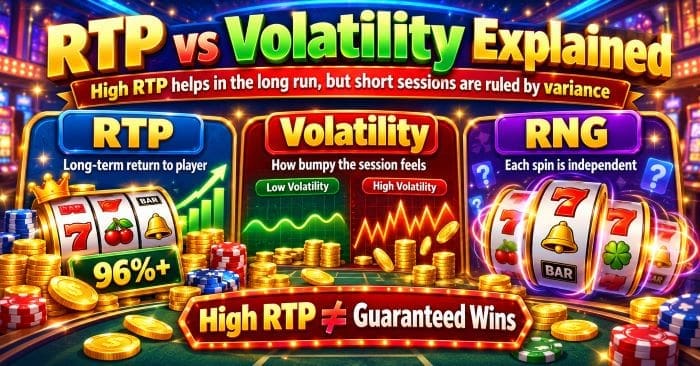
RTP stands for return to player. It indicates how much of all the money betted on a slot is intended to be paid out as prizes by the game. Essentially, RTP is a mathematical calculation of how much a slot is designed to give back to players after a substantial period of play (i.e., thousands of spins). A slot with a 96% RTP is designed to return approximately 96 cents for each dollar bet as prizes. However, the key term here is “a substantial period of play.” RTP is merely a theoretical return, an average long-term return inherent within the design of the slot. It describes the machine, not the session. It is stating nothing about returning 96% of your investment today, nor is it providing any insight into what will occur with your next click of the spin button.
One method to help clarify this concept for many readers is to view RTP similar to how one would view average annual rainfall for a town. In other words, knowing that a particular location receives 800mm of precipitation annually provides factual knowledge about the town’s climate. There is absolutely no indication whether you require an umbrella today.
Additionally, you will notice that RTP is often referred to as payout percentage, and for all practical purposes, they indicate the exact same thing. Some land-based casinos reference payout percentages among a collection of machines located throughout a floor of slots. While somewhat related, in terms of measuring payout percentages among individual online slots, payouts and RTP describe the same statistic.
House edge: the opposing side of RTP
If RTP is the portion that is returned to players, the house edge is the portion retained by the casino. For slots, the house edge is generally close to 100% minus RTP. As an example, a slot machine with a 96% RTP has a theoretical house edge of approximately 4%. Conversely, a slot machine with a 94% RTP has a theoretical house edge of approximately 6%. The difference between the two examples is significant. This represents half again as great an advantage for the casino.
At this juncture, it may be beneficial to discuss expected value in relation to slots, as understanding expected value is essential to accurately interpreting RTP. Expected value in gaming refers to the average return (either positive or negative) resulting from repeated applications of the same action (in this case, placing a bet) as an infinite number of times. For example, if you were to bet $1 on a slot machine with an RTP of 96%, each spin would theoretically generate an average loss of $0.04 per spin. Not because you lose four cents with every spin (and you don’t); rather, it is simply the average loss generated by the long-term behavior of that slot.

Consequently, if you placed 1000 consecutive $1 bets at that slot machine, your expected loss would be $40.00. Additionally, note that “wagered amount” includes every wager placed regardless of whether that wager was funded by cash previously won. Players typically find themselves astonished at how rapidly wagered amount grows. Beginning with a $100 bankroll and betting $1 for sixty minutes can lead to cycling nearly $600-$800 in wagered amount through that slot machine as wins continue to fund subsequent bets. The house edge is applied against all wagered amount.
How does the slot manufacturer obtain the RTP number?
No person plays one slot for billions of spins in order to determine its RTP. Rather, slot manufacturers calculate the theoretical return directly from their slot machine’s mathematical model (each reel strip, each symbol weighting, each paytable value, etc.) and subsequently conduct numerous simulations of potentially hundreds of millions of spins or more to ensure that their model performs as expected.
Subsequently, in regulated jurisdictions, an independent testing laboratory verifies the developer’s work. Laboratories such as GLI, BMM Testlabs, Ecogra and iTech Labs test the random number generator(s), validate the mathematical models utilized in developing the slot machine and confirm that the RTP displayed in advertising material corresponds exactly with the slot’s performance.
Therefore, when referring to “certified RTP”, this terminology denotes that the RTP is linked to a specific version of that slot machine. This clearly differentiates certified RTP from whatever claim a casino makes about RTP in promotional materials.
Another aspect of RTP that many players fail to recognize:
Variable RTP vs. fixed RTP
Many contemporary slot machines are delivered in multiple variations. Typically, a game manufacturer certifies various versions of the same title at distinct rtp levels (for instance: 96%, 94% and 92%). Furthermore, some newer titles offer even lower rtp ranges. The casino operator selects which version they intend to run.
- The reel layouts appear identical.
- The bonus round appears identical.
- The artwork and sound appear identical.
- However, the underlying math model varies.
As such, it is entirely plausible for an article to refer to a game having “a 96.5% RTP” and yet that exact same game running at a lower RTP level at another casino. Therefore, if you wish to ascertain which version of a game is being run at your particular casino, you must check the info panel or help screen associated with that particular game at your casino and review the RTP provided.
Why can’t RTP predict your next spin?
Each spin on any regulated online slot machine is determined randomly via an internal random number generator. At the moment you initiate a new spin on any regulated online slot machine, that random number generator generates a new value representing the reels’ outcomes. In fact, since the outcome is already established before the reels begin spinning (the animation begins only after the outcome has been resolved), spins are independent events. Thus, neither previous spin outcomes nor current results influence future outcomes. Nor can they attempt to revert back to its stated RTP.
In essence, RTP illustrates how all potential outcomes are distributed according to their probabilities. When you spin a wheel (regardless of whether that wheel consists of physical elements or virtual ones), that spin is an independent drawing from that distribution. Therefore, merely knowing the form of that distribution provides zero indication as to which marble will emerge first.
Gambler’s fallacy & hot/cold slot myth
Are previous spin results relevant to future spin results? Absolutely not! Nevertheless, our minds seem hard wired to believe otherwise. When this occurs, it is commonly known as the gambler’s fallacy. Following extended periods without hitting a prize seems to warrant one win shortly thereafter. Likewise, experiencing large rewards leads us to believe that the machine must currently be “cold,” therefore requiring us to abandon ship immediately and move onto another game.
I’ve witnessed players switching games because one appeared to be “tight,” while simultaneously moving onto another game believing it was “about to pop.” Both concepts have absolutely no merit on certified RNG games.
Long-term results vs millions of spins
To explain my friend’s $300 loss: although the house edge is relatively small compared to short-term variance; however, variance remains quite extreme in comparison. Virtually every slot machine possesses standard deviation per spin, which represents how far each individual result deviates from average returns.
For example: low volatility slots may display SD values relative to bet amounts (e.g., 10-15 times bet), whereas high volatility slots (featuring large multipliers and huge max wins) may possess SD values exceeding twenty times your bet. Again, actual figures differ greatly depending upon game type, and developers rarely provide these statistics; thus, use these numbers solely as illustrations.
RTP + volatility = session pairing
While RTP informs you about how much money a slot pays back overall, volatility (or variance) tells you how much money it pays back. Although both slots could present identical RTP values (such as 96%), they can certainly be dramatically different in nature. Think of slot machine A: it returns money on roughly thirty percent of all spins; usually these are small wins equal to or less than your initial wager; plus infrequent but possibly profitable bonus rounds.
Your bank account tends to decline steadily with many minor ups-and-downs. Compare this with slot machine b: it returns money on fewer than thirty percent of all spins; base-game activity appears lifeless for extensive periods; yet eventually, bonus rounds appear with stacked wilds featuring large multiplier values (perhaps yielding fifty-times your original wager). Identical RTP values; unrelated experiences; dramatically different bankroll swings.
As mentioned above, hit frequency (hit rate/win frequency) is simply a synonym for hit frequency — how often does a given spin reward something? Numerous video slots tend to cluster near twenty-percent to forty-percent hit frequencies (though others are decidedly outside this spectrum). These types of slots appear “generous” but they create more ‘wins’, albeit these ‘wins’ are generally smaller than your initial bet; thereby indicating you’re technically winning while still losing money. Are win chance and RTP equivalent? Absolutely not! RTP combines both size x frequency into one single average value. Hit frequency combines only frequency.
Where does the published RTP hide inside the game?
Once you appreciate this aspect of reading slot machines, the headline RTP presented for each slot machine can be divided amongst different components within the game. A certain portion originates from base game winnings on paylines/ways to win, and another portion arises from features: free spins bonuses triggered by scatter symbols; feature-rich bonus rounds with multiplier values; progressive jackpots. On many modern slots, free-spins bonuses contribute significantly to the overall return. Many game developers include a separate base game RTP besides the total; and you’ll observe instances where the base game alone returns less than fifty percent of the overall listed RTP value.
As such, although you played for a relatively short duration and didn’t hit either bonus round feature, you effectively played with substantially lower effective return rates than represented by the headline numbers. As explained earlier – this isn’t deceptive – this is simply how payout distributions are created. Yet – this helps illustrate why numerous gamers consistently experience sessions far worse than indicated by their respective game’s reported RTP value.
Progressive jackpot slots extend this principle even further: each bet contributes towards building an ever-growing jackpot pool – and although RTP figures routinely contain contributions toward said jackpot pool, given how extremely improbable landing such jackpot prize money is, your realized return will ultimately be lower than indicated by either certification or advertised.
Bonus buy impact upon RTP:
More frequently than not — yes; bonus buy typically causes an increase in rtp. Bonus buy allows you to purchase direct access into bonus round(s) — almost universally by paying a predetermined fee (commonly seventy-x or one-hundred-x your bet – though fees vary depending on game). Most games list bonus buy RTP separately — which may represent an identical or slightly greater return (but on occasion lesser) compared to the regular return offered by the standard version.
FAQs
What does RTP stand for in Slots?
It’s the percentage of every dollar bet a slot machine will give out in winnings through all of its random number generator (RNG) events, which are spread over many years and among thousands of players. So a 96% RTP slot gives the player approximately $96 for each $100 they bet over a period of time of millions of spins combined with thousands of players; it does NOT indicate the amount returned to the player per session or per person.
Will RTP assure I win money from Slot Machine games?
No. An RTP rate of less than 100% indicates the game has been designed such that the house as a whole loses money. RTP cannot provide anything to an individual, whether it be winning money or losing money.
Will RTP tell me what my next Spin will produce?
No. The RTP rates describe the probability of receiving various combinations of symbols during the course of a long series of plays; however, since each spin is a new Random Number Generator (RNG) event, there is no way RTP can determine the sequence of occurrences (what happens first).
Is a 96% RTP Slot Game Good?
Typically speaking, 96% is near average RTP for Online Slots. Therefore, a 96% RTP Slot is generally acceptable. A Slot with RTP greater than 96% would have a better-than-average payout. Conversely, a Slot with an RTP significantly lower than 96%, i.e., less than 94%, may have serious issues, especially when compared to other versions of the same Slot game.
How do I compare RTP and Volatility?
Volatility represents how frequently a Slot pays smaller amounts verses paying larger amounts. For example, some Slots pay off relatively often but only slightly. Other Slots rarely pay off, but when they do, the payouts tend to be bigger. To gain a full understanding of a Slot Game, you need to know both figures.
Does RTP change throughout a Session?
The RTP certification for the specific Version being played by you does NOT change due to your results. In other words, the Slot machine is neither getting looser nor tighter while you’re playing. Instead, what varies is your Actual Return During Your Session.