
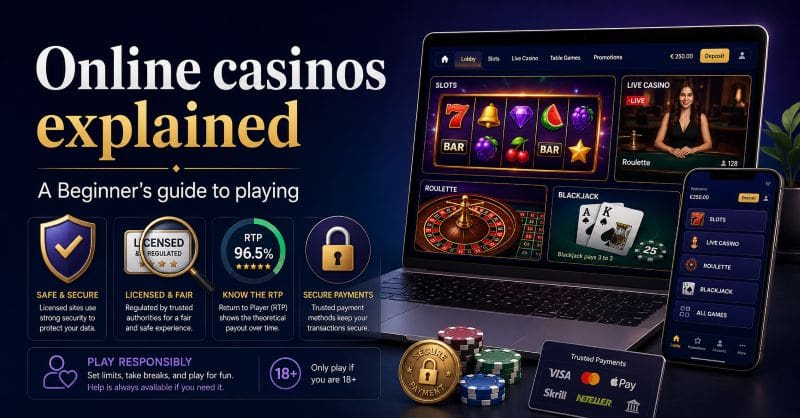
Online casinos explained: A Beginner’s guide to playing
When most new players visit an online casino for the first time, they either feel overwhelmed with the variety of games offered or feel uneasy with uncertainty as to what they are getting themselves into. Both feelings are perfectly normal. As we mentioned earlier, online gaming has grown into a multi-billion-dollar global market, and the casinos’ websites look professional and welcoming enough to give you confidence that the casino is reliable – even if it isn’t. That gap between looks and reliability is the reason why many new players fall victim to scams.
This article is about filling that gap. We’re not trying to scare you off. We’re simply going to tell you to keep your eyes wide open.
What an Online Casino really is?
At its core, an online casino is nothing more than a digital version of a physical casino. There are a couple of ways to access an online casino: through your computer’s web browser or via a downloadable casino application. Once inside an online casino, the games are displayed digitally (often using Flash), and your Deposits and withdrawals go through electronic payment processors similar to those used for other e-commerce transactions.
Whereas online shopping provides you with a predetermined price and product description, the outcome of every game in an online casino is random. Random outcomes in an online casino are produced by a “random number generator” or RNG. The RNG creates results that cannot be anticipated or manipulated by either the player or the casino. Legit online casinos have their RNG tested and validated by third-party organizations (such as eCOGRA, iTech Labs, and Gaming Laboratories International) and post evidence of this testing on the front page of their website. If you see no reference to any testing agency, it may be a warning sign. While some games (live table games) utilize a true hardware RNG, they instead feature a real-life dealer operating actual cards/roulette wheels in a remote studio that streams the game to you in real-time. Well-known companies like Evolution Gaming and Pragmatic Play live-produce products based on this model. This format mimics playing at an offline casino, but many gamers find it easier to trust live-action games simply because you can observe the cards being shuffled and/or the ball bouncing on the wheel yourself.
License and why license matters
The most important step a new gamer can take prior to putting any money down is determining who granted the online casino a license. All that this requires is approximately thirty seconds of research.
All legitimate online casinos operate with licenses from recognized governing bodies that oversee aspects of a casino, including player safety, fairness testing, and responsible gaming practices. Although there are several regulators throughout the world, some of the most prominent include: the United Kingdom Gambling Commission, the Malta Gaming Authority, the Gibraltar Regulatory Authority and the Kahnawake Gaming Commission. You may also see references to casinos regulated by Curacao, although Curacao eGaming has issued licenses to numerous reputable casinos; their regulation process is less stringent than other jurisdictions, meaning that some casinos regulated by them may provide fewer safeguards for consumers.

Offshore casinos that have not received any type of gaming license and/or operate with a license from a jurisdiction that does not enforce regulations for gaming operations represent an entirely different situation. While they are not necessarily dishonest, in the event that something goes amiss, there are very few avenues available to assist you. The primary function of a regulatory agency is to act as a neutral referee; therefore, absent a license, you are essentially relying solely upon the goodwill of the casino.
In general, you can determine whether an online casino is licensed by looking for the license in the bottom section of the online casino’s webpage. Simply click on the license logo and it should redirect you to the regulatory authority’s webpage confirming the legitimacy of the license. However, if clicking on the license link redirects you to a blank webpage, consider this a red flag.
Games: What you will find
Most new players spend more time researching a casino’s game offerings than any other aspect. The sheer number of games hosted by most online casinos is staggering. In addition to the sheer number of games offered by each casino, each casino draws upon multiple third-party game suppliers. Of course, slots account for the largest share of games offered primarily due to their ease of use. Slots from a multitude of vendors (including NetEnt, Microgaming, Pragmatic Play, Play n Go, Yggdrasil, and Quickspin) cover a vast spectrum of style from traditional 3-reel fruit machines to highly complex video slots featuring cascading reels, multiple bonus rounds, and progressive jackpots that can total hundreds of thousands of dollars.
While the sheer number of slots accounts for roughly 75 percent of all games offered by online casinos, table games offer strategy. One of the most popular table games offered at online casinos is blackjack due largely to the fact that when playing basic blackjack strategy correctly, the House Edge of blackjack is relatively low (less than .05%). Roulette is another popular table game offered by online casinos, and it comes in two forms: European roulette and American roulette. While both versions share many similarities, there is a significant difference between the two versions in regard to House Edge. European roulette has only one zero on the wheel, creating a House Edge of 2.7 percent. Conversely, American roulette has a second zero (double zero) on the wheel, increasing the House Edge to 5.26 percent. As you can probably imagine, this difference becomes extremely relevant after extended periods of play.
Video poker and multiplayer poker
Video poker and multiplayer poker exist in two formats. Video poker is a solitary machine game, while multiplayer poker is played against other players. However, multiplayer poker is less commonly found at online casinos and is more commonly found at dedicated poker platforms.
Baccarat
Although Baccarat has been viewed as an exclusive high roller game for years, Baccarat is actually one of the easiest games to learn and offers nearly identical house edges as blackjack when betting on the banker.
Live dealer games
Live dealer games bring all types of games offered at online casinos to life with actual human dealers. Many new players report feeling more comfortable with live-action games due to their ability to view actual cards being shuffled or actual balls spinning around a virtual wheel.
Understanding RTP & House Edge
Of all statistics associated with casino gaming, return-to-player (RTP) and House Edge are arguably the most important. In fact, they are two sides of the same coin.
RTP is expressed as a percentage representing how much money per dollar wagered is returned to players over an infinitely large number of plays/hands. For example, if a slot machine boasts an RTP of 96%, then theoretically it will return $96 for every $100 wagered over its lifetime. Obviously, since RTP values represent averages, your individual session(s) will greatly differ from these long-term averages – and this is both what contributes to the thrill of gaming as well as what leads to long-term mathematical disaster.
Highest RTP slots average in excess of 95-98%. Some video poker variants played optimally approach or exceed 99%. Generally speaking, any slot machine with RTPs lower than 94% should be avoided unless you truly enjoy playing the game despite terrible odds.
Oftentimes you can locate RTP percentages in the game information panel/paytable for each slot machine title. Failing to locate RTP percentages easily accessible may necessitate conducting an internet search using your desired game title and ” RTP “.
Slot volatility (variance)
Another often overlooked concept by new players is slot volatility (commonly referred to as variance). Low-variability slots pay smaller wins more frequently, whereas high-variability slots pay fewer wins but in larger increments. Neither form of volatility is inherently good/bad – it ultimately depends on your personal bankroll size and preference on how you wish to gamble.
For example: assuming you have a small bankroll with a high-volatility slot machine; if you go on a losing streak before hitting a large win – your bankroll could dwindle rapidly. Conversely, assuming you have a large bankroll with a low-variability slot machine, your bankroll may decrease gradually as you collect smaller wins consistently.
Bonuses – What players need to understand about bonuses
Casinos’ promotional bonuses are what they tend to highlight during marketing efforts – and they can indeed be rewarding; however, they rarely ever work as advertised. Welcome bonuses are one type of bonus offered by casinos: welcome bonuses match new players’ first deposit by a certain percentage (which varies depending upon which casino you choose), occasionally reaching up to 100% or more – along with free spins for specific slots. No deposit bonuses allow new players to receive small amounts of credits for registering without having to place a deposit.
The major catch with both welcome bonuses and no deposit bonuses is wagering requirements – also known as play-through requirements. If a casino awards you $100 in welcome bonus funds with a 30x wagering requirement, you will need to wager $3000 ($100 x 30) before you will be able to withdraw any winnings generated from this bonus fund. Based on our previously discussed RTP statistic, statistically speaking, wagering through $3000 @ 96% RTP slot will require $120 in losses. While this does not mean that bonuses are useless, it does mean that you need to carefully examine bonus terms before agreeing to participate.
Wagering requirement ratios vary widely between casinos
Some casinos offer bonuses with 10x-20x wagering requirements, which can be reasonable. Other casinos have much larger wagering requirements such as 50x or 60x, which are essentially impossible to beat under any circumstances.
Bonus terms also specify which games contribute towards meeting the wagering requirement and at what percentage contribution each game offers toward clearing the wagering requirement. Typically, slots count 100 percent toward meeting the wagering requirement, while table games like blackjack may only contribute 10 percent or less toward meeting the wagering requirement due primarily to their higher RTP values, which would otherwise make it far too easy to burn through the wagering requirement.
Sticky bonus (non-cashable bonus)
There is yet another variation of bonuses: sticky bonus (also referred to as a non-cashable bonus): sticky bonus funds are usable for generating winnings – but winnings from sticky bonus funds cannot ever be withdrawn – only winnings generated using those sticky bonus funds can be withdrawn.
If you are unsure whether a bonus is sticky or not, check the casino’s terms and conditions – sometimes they hide it.
How money transfers
Both Deposits and withdrawals represent practical friction points for gamers.
Many reputable online casinos offer various methods of payment including credit cards (Visa and Mastercard), e-wallet services (such as PayPal), bank transfer options (like Trustly or Interac depending upon where you reside), prepaid solutions (such as Paysafecard), and increasingly cryptocurrencies (Bitcoin and Ethereum via platforms such as BitPay or Coinbase).
Almost always, instant Deposits follow shortly after funding your account.
Withdrawal processing times vary significantly depending on the method of withdrawal and casino policy; however, most reputable online casinos complete e-wallet withdrawals within twenty-four hours to forty-eight hours post-request.
Bank transfer withdrawals often take three to five business days.
Credit card withdrawals usually fall somewhere in between: typically taking two to four business days post-request.
Before your first withdrawal, virtually every licensed online casino requires completion of know your customer (“KYC”) verification prior to allowing any withdrawals. To verify your identity, you’ll need to provide proof of identity (passport/driver’s license), proof of residence (utility bill/bank statement), and occasionally proof of source/payment method.
This is a mandatory regulation required by government agencies to prevent money laundering.
What Makes a Casino Reliable?
Aside from obtaining a license, there are several additional signs that differentiate reliable online casinos from unreliable ones.
One key indicator is payout speed — instant withdrawal casinos do exist (although they are still rare) — and if you can find one that allows fast payouts, that will likely save you hassle later down the road.
Another indication is ssl/tls encryption — which protects user data — and which should be present at any serious online casino; an ssl/tls connection ensures encrypted communication between client browsers and server-side applications.
Additionally, PCI-DSS compliance indicates that credit card data was collected safely.
And finally, customer service — although boring — can be indicative of how seriously an operator treats customers: live chat should connect you with someone knowledgeable within minutes, 24*7; email support should respond promptly; help centers should provide clear answers quickly.
Mobile gaming
Mobile gaming has become an acceptable norm for many users rather than an exception for many users today. Today, most modern casino games are built on HTML5 technology, allowing them to be accessed directly through a mobile device’s web browser without needing to download anything special. Mobile casino applications are becoming more prevalent; however, mobile casino apps typically offer quicker loading speeds and sometimes unique mobile-specific promotions. Ultimately, what really matters when comparing mobile gaming via a mobile browser versus via an app is whether or not the casino website’s design has been properly optimized for mobile devices. An online casino that loads smoothly on desktop but functions poorly on your smartphone will cause frustration — especially when playing live dealer games where timing counts more than anything else.
Beginning
Responsible Gambling: For Real This Time – the Tools That Help Save You Money
Every casino operator that holds a valid operating license is required to implement responsible gaming measures. These aren’t just marketing gimmicks; they’re functional. Deposit limits allow you to set a limit on how much money you can deposit over a specific time frame (day, week, month). Loss limits do the same thing, but limit how much money you can lose within a specified time frame. Session time limits or Reality Checks remind you how much time has passed while playing. When you choose self-exclusion, you remove yourself from accessing a casino (and, using programs such as GamStop in the U.K., other licensed casinos) for a predetermined amount of time.
Why? They exist for two reasons.
Casinos are required by law to implement this feature as part of their operation, but they also exist because problem gambling is a serious issue that organizations like GamCare, BeGambleAware, and the Responsible Gambling Council help support individuals with. If you find yourself unable to stop playing even though you planned to, if you continue chasing losses despite knowing better, or if you lie about where you are or what you’re doing regarding your gambling to friends or family members, there are legitimate places to go for assistance during these times.
There is only one tip that all seasoned players will share with new players regarding preventing themselves from losing too much money in online casinos: Set a session budget prior to logging in and treat that money as money that you’ve lost instead of as potential winnings. Online casinos generate revenue using the House Edge. There isn’t any memory associated with the Random Number Generator used in the majority of games. What occurred on the previous game rotation has no influence on the outcome of the subsequent game rotation – no matter how it may seem in the heat of the moment.
Choosing a New Casino
Although several factors can contribute toward selecting a suitable online casino, a combination of elements is far more important than each element individually:
Begin by checking for licensing: Look for a UK Gambling Commission or Malta Gaming Authority license as your first choice. Next, examine whether the games were independently audited by a third-party company such as eCOGRA. Examine the payment options available and ensure that at least one option supports your geographical area. Review various articles and opinions from established casino review websites; however, consider those reviews to be somewhat biased since they are driven by affiliates. Instead, browse through user forums and community comments to see whether users complain about withdrawing funds or difficulties related to the customer support team. These issues typically surface more frequently in those types of areas.
While the welcome bonus is certainly something to think about when choosing an online casino, base your decision on the wagering requirements rather than its headline value. A $100 match bonus with 40x wagering requirements is less attractive than a $50 match bonus with 15x wagering requirements. The actual numbers provided in the promotion ultimately determine its true value.
Before you place any type of deposit, I recommend testing out the demo version of the games. Although most slot games and numerous table games include demo versions that utilize virtual chips rather than real currency, they allow you to test the game and learn how to operate the different features without risking real money. In addition to allowing you to experience the gameplay firsthand, demo versions also assist you in determining whether you truly enjoy the overall experience before placing any deposits.
Online casinos that enable you to test games without placing any type of deposit and clearly display their terms & conditions will likely provide you with good experiences. Those online casinos that attempt to rush you into making a deposit, obscure their terms & conditions, and create obstacles for you when attempting to withdraw your funds will likely provide poor experiences. Once you become familiar with what to look for in both cases, identifying those differences is relatively simple.